OpenAI Says Its Models Disproved a Famous Computer Science Hypothesis
OpenAI says its unreleased models disproved the Exponential Time Hypothesis, proved a 35 year old wave conjecture, and produced a rigorous proof tied to quantum chromodynamics.
Three claims, each famous on its own
OpenAI announced three new research results on the same day, and The Neuron and The Rundown AI both led with them. The company says its unreleased models made discoveries across computer science, mathematics, and physics, weeks after a release of 722 mathematics papers showed how much research volume these systems can produce.
Volume is not the story this time. Each result sits on ground that whole fields have organized themselves around for decades. If even one holds up, it changes what researchers can assume when they start work.
The hypothesis underneath hundreds of papers
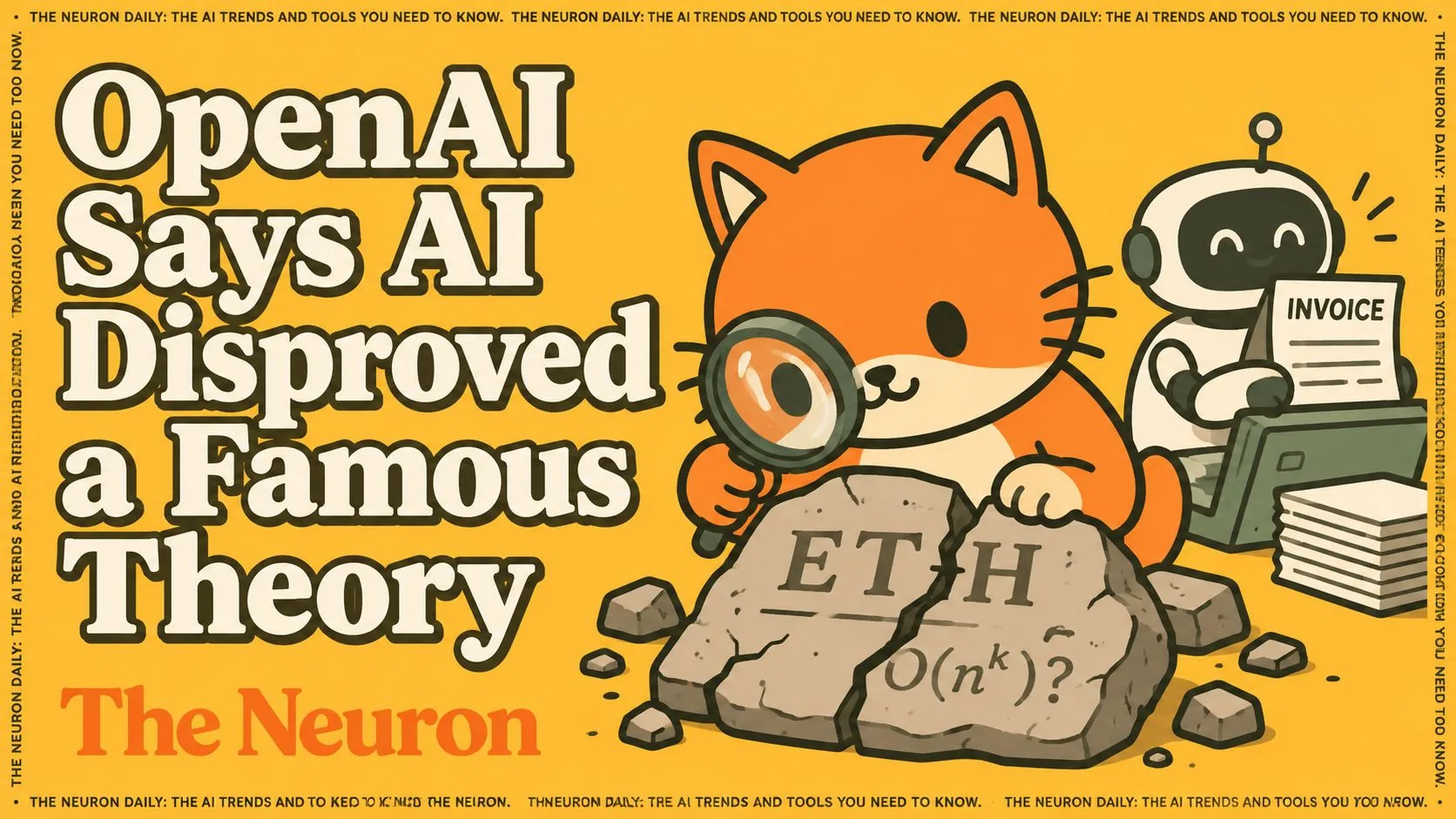
The boldest claim concerns the Exponential Time Hypothesis. As The Neuron explains it, the hypothesis concerns a puzzle built from true or false switches and a list of rules. The question is whether any setting of the switches can satisfy every rule at once. Known methods get exponentially slower as switches are added, and the hypothesis says nothing fundamentally faster exists.
Hundreds of papers in fields from databases to computational biology use that assumption as a starting point. OpenAI says its system found the disproof on October 16. If the claim holds, a long list of results that say a problem cannot be solved faster become open questions again.
The people checking it proposed it
Here is the detail that makes this claim testable in public. A proof checking program called Lean verified the formal result the day after OpenAI says the system found it, according to The Neuron. Lean works like a strict checker for logic, confirming that every step follows from the step before it.
Beyond the software, a working group is reviewing whether the claim means what it appears to mean. The Rundown reports that the scientists who first proposed the hypothesis are part of that review, and The Neuron names Russell Impagliazzo and Ramamohan Paturi, two of its three original authors, in the group.
Waves and the strong force
The other two claims are just as ambitious. OpenAI says its models proved the local smoothing conjecture, a 1991 problem about how waves focus, in every dimension. It also says the models produced a rigorous existence proof for quantum chromodynamics, the theory of the strong force, and The Rundown connects part of this work to a Millennium Prize problem worth $1 million.
A review group led by Nobel laureate David Gross is handling the physics result carefully. The Neuron reports that the group is holding back its own account while it writes up its view. OpenAI says it does not seek academic credit for the results and agreed to release its raw data on the hypothesis so anyone can check the work.
Raw data is not a finished verdict
OpenAI is unusually plain about how early this is. The Neuron notes that the company calls its manuscripts raw research data, and turning a disproved hypothesis into faster real world software would take significant further research. A formal checker can confirm that a proof follows its own steps. It cannot, by itself, settle whether the claim was framed the way the field meant it.
That is why the expert verdict matters more than the announcement. A filled out form takes seconds to verify. A proof of a 35 year old conjecture takes months, a working group, and, in this case, a conference OpenAI has agreed to fund.
The habit worth copying
You do not need to follow theoretical computer science to use the lesson here. The strongest claim in the room was published together with its raw material, a machine check, and a review by the very people who built the field being challenged.
That is the standard to hold any AI output to, including your own. Show the work. Run an independent check. Let the person who loses if the claim is wrong examine it. Verification decides whether historic looking results are historic.
Sources and further reading
- The Neuron: OpenAI big day brought a disproof and Terra (October 27, 2026)
- The Rundown AI: OpenAI next batch of AI science discoveries arrives (October 27, 2026)
Sources were checked for this article. Tool features, prices and availability can change. Product claims are attributed to their publishers.