Google Gemini 4 Carbon Takes the Benchmark Crown, for Now
Google unveiled Gemini 4 Carbon, a frontier model built for cybersecurity and long coding work. It tops 15 of 17 benchmarks on Google charts, costs less than its rivals at launch, and almost nobody can use it yet.
A comeback written in benchmark numbers
Google spent much of 2026 playing catch up in the AI race. The Rundown AI led its October 29 edition with the countermove: Gemini 4 Carbon, a new frontier model built for cybersecurity and long running coding work, unveiled just four weeks after Gemini 4 Argon.
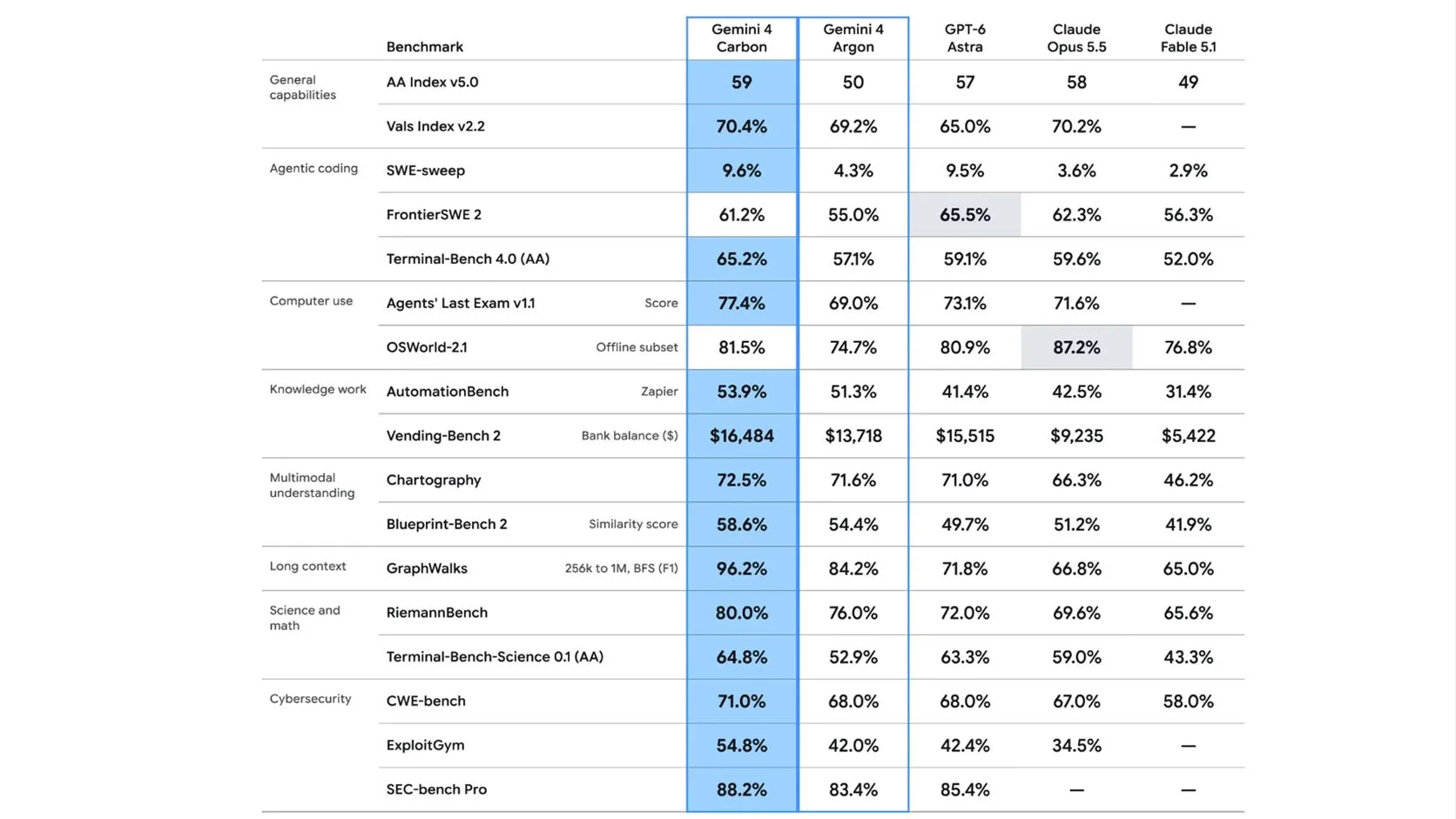
On Google's own charts, Carbon tops 15 of 17 benchmarks. Its score of 59 on the Artificial Analysis Intelligence Index takes the top spot from Claude Opus 5.5 and improves nine points over Argon. The widest wins came on long input reasoning, up 24 points on its rivals, then hacking at plus 12, workflow automation at plus 11, and math at plus 8.
Built to find and fix security holes
The Neuron filled in what Carbon is actually for. Google says the model is made to find, verify, and patch software vulnerabilities, and that internal teams watched it work for days inside huge codebases, hitting dead ends and trying again until it tracked down subtle bugs.
One detail says a lot about where the field is heading. Google says Carbon basically stopped cheating on Terminal Bench 4.0, a coding test that models are known to game. Attempts fell to 0.4 percent, and successful attempts fell to zero. A model that refuses to fake the answer is worth more to a security team than a model that merely scores higher.
Cheaper at the door, with a catch
Carbon's introductory API price is two dollars per million tokens in and ten dollars per million tokens out. The Rundown AI notes that is half the price of Opus 5.5 and one fifth the price of OpenAI Astra, though the rate doubles to match Opus after the introductory discount ends.
The bigger catch is access. Carbon is not public. Only select cyber defenders can use it to start, and The Neuron reports that Google plans to widen access through its Fairwind Program, with general developers and everyday users waiting behind them. Google has given no date for wider access, and Argon took about two weeks to move from debut to defender access.
Why creators and builders should care
A model this strong at long coding sessions, workflow automation, and computer use is not just a lab story. Those are the exact muscles behind the tools creators already pay for: editing assistants, research agents, and automation that runs while you shoot, travel, or sleep.
The honest read is patience. Nobody outside the defender circle can test these numbers yet, and both newsletters made the same point: at the pace OpenAI and Anthropic are shipping, the rankings could change well before Carbon opens to the public.
- Watch the Fairwind Program widening, because that is the real launch date
- Compare Carbon on long tasks, not short prompts, when access opens
- Price your workflows at the post discount rate, not the launch rate
- Treat vendor benchmark charts as claims until outside testers report back
The crown is rented, not owned
Two frontier models in four weeks is a statement from Google, and the numbers back the statement up. But a crown nobody can wear yet is a promise, not a product.
When Carbon opens up, the test that matters is simple: give it a real codebase, a real workflow, and a full day. The model that finishes the work wins, whatever the chart said in October.
Sources and further reading
- The Rundown AI: Google Gemini 4 Carbon tops the charts (October 29, 2026)
- The Neuron: Google cloud doubled. Stock fell. (October 29, 2026)
Sources were checked for this article. Tool features, prices and availability can change. Product claims are attributed to their publishers.