
Walmart Spent Billions on Warehouse Robots. They Still Struggle With Dog Food.
Walmart has spent billions over a decade trying to fully automate the warehouses that feed its 5,200 stores. The progress is real: most stores now receive some automated freight. So is the catch. Electric bills triple, about 5 percent of the robots are broken at any given time, and the machines still cannot handle the big bags of dog food.
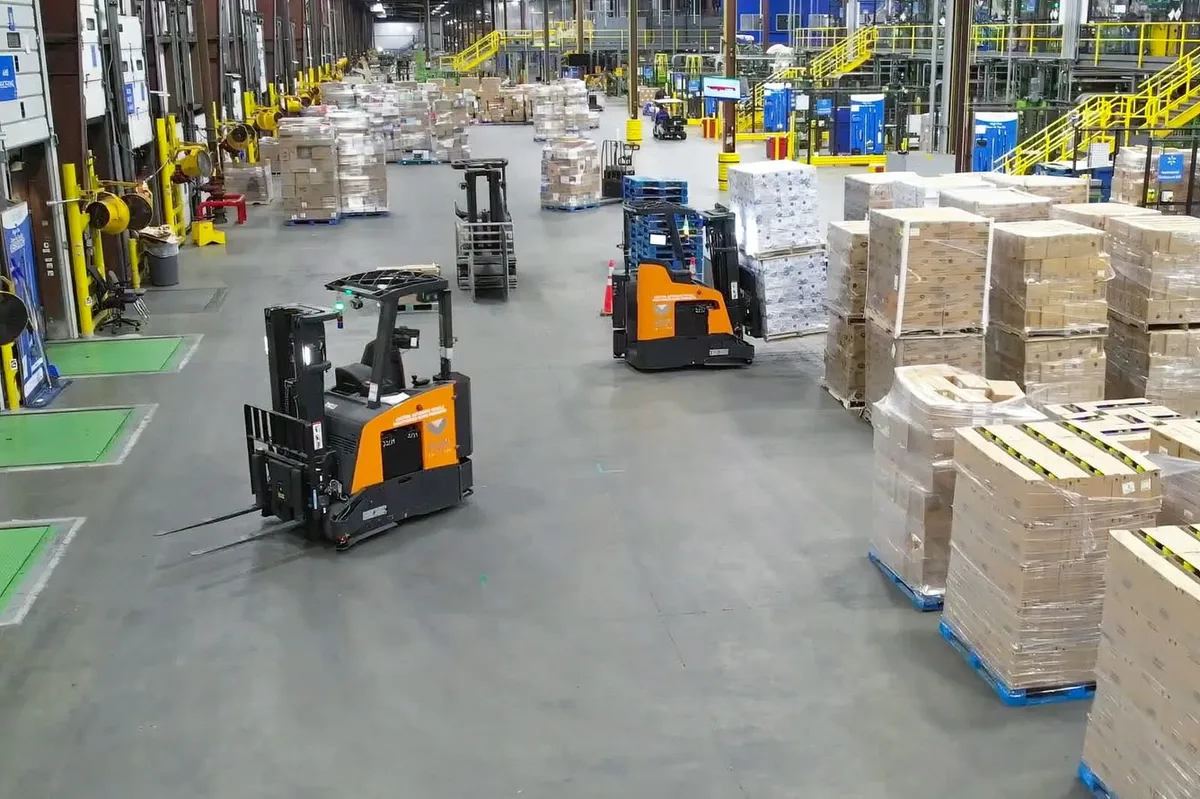
The dream: nobody touches the product until the shelf
In Walmart's perfect world, Morning Brew reports, a worker would not touch a product until it arrived at the store already organized on a pallet, ready to slide straight onto the shelf. The company has spent billions over the last decade chasing that picture across the 200 supply chain buildings that feed its 5,200 stores, racing Amazon, which passed Walmart as the biggest company in the world by 2025 sales.
Retrofitting a supply chain designed in the 1980s is the hard part. This is not a new building drawn around robots. It is an old machine being rebuilt while it runs, at national scale, every day.
What the robots cost, in power and in patience
A Wall Street Journal report covered by Morning Brew lays out the friction in plain numbers.
- Automated grocery facilities can run electric bills above 800,000 dollars a month, compared with about 250,000 dollars for a manual warehouse
- Roughly 5 percent of the warehouse robots are being repaired at any given time, improved from 10 percent last year, according to robotics partner Symbotic
- The robots still cannot lift the biggest, heaviest items, including large bags of dog food
- Walmart missed the automation targets it had set for January of this year, then nearly caught up by August
- More than 65 percent of stores now receive some automated freight, and over half of online order goods move through automated systems
Automation did not fail. It compounded.
It would be easy to read those numbers as a punchline about robots, and that reading misses the story. A system that moves more than half of a retail giant's online goods, while 5 percent of its machines sit in repair, is not a failed experiment. It is an expensive adolescence. The failure rate halved in a year. The targets slipped by months and then nearly landed. That is what real automation looks like inside a business that cannot pause to install it.
The dog food detail matters for the same reason. Automation eats the repeatable middle of a job first: standard boxes, standard weights, standard routes. The odd, heavy, awkward edge cases stay human longest. Planning a business around automation means knowing which part of your own work is the standard box and which part is the dog food.
The lesson for smaller operators
Walmart can absorb a decade of billions and a warehouse power bill that triples. A small business cannot. What it can copy is the order of operations: automate the highest volume, most repeatable step first, measure what breaks, and let the savings fund the next step. The companies that get hurt are the ones that buy the full robot future up front, then discover their edge cases were the business all along.
See our business websites and growth work
Sources and further reading
Sources were checked for this article. Tool features, prices and availability can change. Product claims are attributed to their publishers.