The Future of Work Is Multiplayer, Not One Person and One Chatbot
The Neuron argues AI is moving from personal assistants to shared team workspaces, where people and agents build on the same context instead of passing files around.
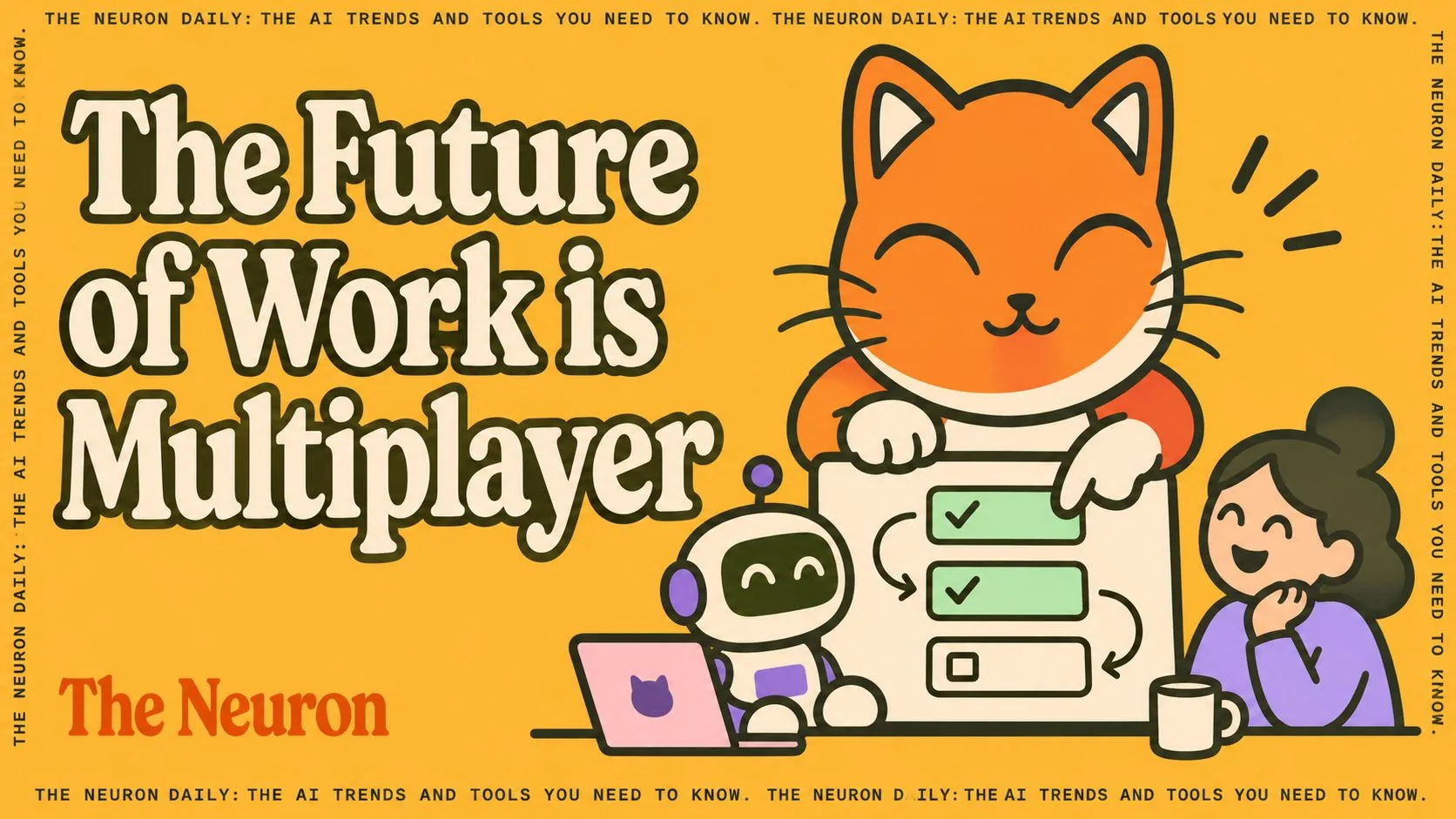
Everyone has an AI assistant. Nobody has an AI team.
The Neuron devoted its November 14 deep dive to a plain question: what happens when AI stops being your personal assistant and starts working alongside the whole team? Today you can ask one AI to research a project, another to write a proposal, and a third to build an app. The outputs might be excellent, but you still explain the assignment three times, move the files yourself, and reconcile the answers when they disagree. You become an overqualified copy and paste machine.
The cost of that stitching work is measurable. The Neuron cites Microsoft and its 2025 Work Trend Index, which found that the most heavily interrupted users received an average of 275 meeting, email, and chat notifications across a 24 hour workday, roughly one interruption every two minutes during core working hours. A personal assistant can summarize a message. It cannot fix a team where one assistant knows the research, another knows the plan, and a third never heard the deadline changed.
What changes when the context is shared
Multiplayer AI aims to give people and agents shared context, clear responsibilities, and one place to move work forward. The Neuron walks through an illustrative launch: a small company bringing a subscription service to market in three weeks, where research, planning, and content agents work from the same project. When research finds the feature customers care about most, content can use it without anyone pasting it into a fresh chat. When planning spots a conflict, the fix becomes part of the record.
For an agent to be a real teammate, The Neuron says it needs four things. Shared context: the goal, the latest information, and the decisions already made. Ownership: a defined task and a person accountable for the outcome. Tools and permissions: access to what the job needs, without unrestricted authority. And continuity: a record of what is finished, blocked, or waiting on approval. Miss one of the four and smart agents will produce incompatible answers.
More agents do not automatically mean better results
The research cuts in both directions. A 2026 field experiment published in Organization Science followed 791 professionals at Procter and Gamble and found that individuals working with AI produced product innovation solutions comparable in quality to two person teams working without it. AI also helped people borrow perspectives beyond their own specialty, with technical staff weighing commercial questions and commercial staff drawing on technical ideas.
But a 2026 study in Nature Machine Intelligence tested 260 multi agent configurations and found that adding agents did not consistently improve performance. When one agent was already capable, coordination added overhead instead of value. Worse, agreement is not validation. If a research agent misreads customer feedback, a content agent can turn the error into a confident promise and a planning agent can build a schedule around it. Three agents can agree on the same mistake at impressive speed.
Set the boundary between preparation and commitment
The Neuron lands on a boundary every small team can use this week. Let agents prepare: collect information, compare options, and draft inside a shared workspace where inputs and changes stay visible. Keep commitment human: sending anything outside the company, changing a customer record, or spending money should require explicit authority from a named person. That split lets work move fast without becoming a mystery when something breaks.
For a creator business, start with one recurring project. Put the brief, decisions, and deadlines in one shared place your tools can read. Give each agent one owned job, review its output where the team can see it, and count whether handoffs shrink. The company that wins with AI will probably not be the one running the most agents. It will be the one whose people and agents share one version of the truth, with a human in charge of the calls that count.
Sources and further reading
Sources were checked for this article. Tool features, prices and availability can change. Product claims are attributed to their publishers.