Meta Muse Ember Does Agent Grunt Work at a Third of the Rival Cost
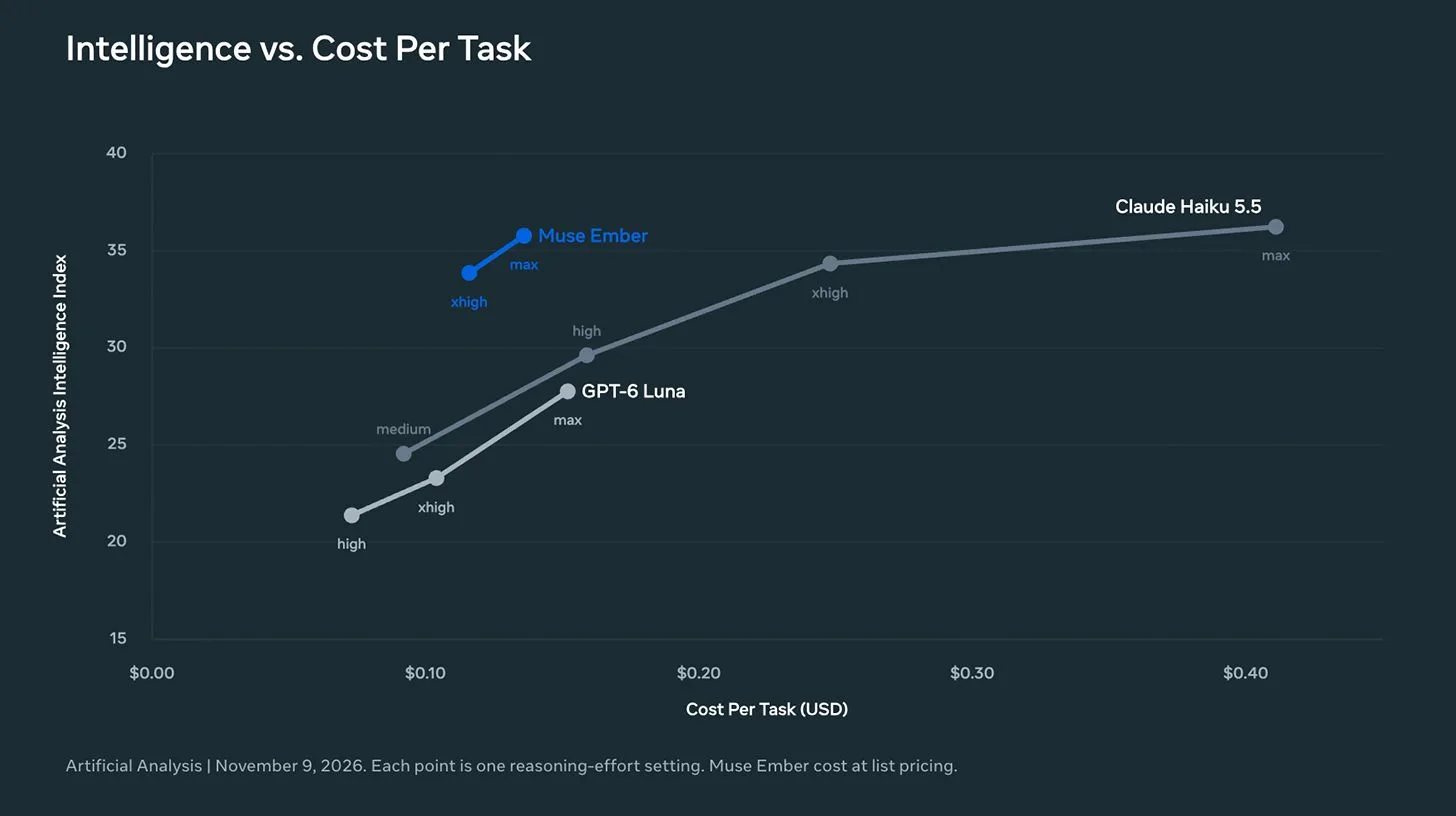
Meta Muse Ember matches Claude Haiku 5.5 on intelligence scores while an average test task costs 14 cents against 41 cents, by using fewer tokens per job.
The price war moved from chat to chores
The Rundown AI reports that Meta has released Muse Ember, the smallest model in its Muse lineup, built for the routine high volume steps inside AI agents. Ember tied Anthropic budget model Claude Haiku 5.5 at 36 on the Artificial Analysis Intelligence Index, and it beat OpenAI comparable GPT 6 Luna, which scored 28, by a wide margin. On raw smarts for small jobs, the bargain model is no longer a compromise.
The cost story is sharper than the score story. Ember sticker price matches its rivals, and the savings come from efficiency: it uses fewer tokens to finish the same job. An average test task ran about 14 cents on Ember and about 41 cents on Haiku. Same neighborhood of quality, roughly a third of the bill, repeated thousands of times a day inside an agent that never sleeps.
Wonder plans and Ember carries the boxes
Meta AI chief Alexandr Wang framed the pairing in one line quoted by The Rundown: wonder can plan, ember can handle the volume. The large Muse Wonder model does the thinking that needs judgment, and Ember runs the repetitive steps around it: tool calls, routing, data extraction, and long document reading. It is the oldest structure in business, a senior who decides and a fast junior who executes, rebuilt in software.
Meta also says Ember was trained using its larger Muse Wonder Full, the first model in the family built that way, and that even more efficient models are already in training. Meta shipped its first Muse model in April, and it now fields an answer at every tier Anthropic and OpenAI sell, from near frontier performance down to the bargain bin where agents actually spend most of their budget.
Why per task cost is the number that matters
Most buyers still compare models by headline token prices, the way people compare cars by the price of gasoline. Agent work flips the math. What you pay for is a finished task: a lead researched, an inbox sorted, a transcript cleaned, a report drafted. A model that thinks longer and bills more tokens per step can cost triple while wearing the same sticker price, and the chart in this story shows exactly that gap.
For a small operator, that gap decides what automation is even allowed to exist. At 41 cents a task, a workflow that runs a few thousand times a month is a real line item that needs defending. At 14 cents, the same workflow becomes background infrastructure, cheap enough to run on every lead, every event, and every client file without a meeting about it first.
Split your own stack the Ember way
Steal the structure even if you never touch Meta models. List the AI tasks your business runs every week and sort them into two piles: work that needs your best model and your full attention, like strategy, client facing writing, and final creative calls, and work that is pure volume, like sorting, tagging, extracting, formatting, and first pass summaries. Route the second pile to the cheapest model that clears your quality bar, and test it on real jobs before you trust it.
Then reinvest the savings where they compound. Cheaper grunt work is not the prize by itself. The prize is the hours and dollars it frees for the work clients actually pay a premium for: showing up, shooting well, deciding fast, and finishing strong. Meta is selling efficiency. Smart operators will buy back their attention with it.
Sources and further reading
Sources were checked for this article. Tool features, prices and availability can change. Product claims are attributed to their publishers.