Claude Now Grades Its Own Conversations for Abuse
Anthropic gave Claude a second job: after every reply, the model reviews the conversation and flags possible misuse for humans. It has been running since June and already surfaced abuse at serious scale.
The model reads its own report card
Anthropic has given Claude an unusual assignment: watch itself. The Rundown AI reported on October 30 that the company introduced self assessment, a technique where Claude reviews each conversation after it replies and flags possible misuse. The system has been active since June, quietly catching large scale abuse that might otherwise slip past.
After each exchange, Claude gives the conversation a quick safety verdict: whether it looks harmful, what kind of harm it might be, and how urgent it is. Those verdicts help human reviewers decide which cases deserve attention first, which matters when abuse arrives by the thousands.
The numbers Anthropic published
On Claude Fable 5, self assessment catches 78 percent of potentially harmful conversations that a stronger classifier flagged, and 94 percent of the high priority ones, at a false positive rate of just 1 percent. For a layer that runs inside the same model doing the chatting, that is a strong hit rate.
The catches are not theoretical. Anthropic says the system helped uncover more than 100,000 child abuse flags tied to a single API customer, which were reported to authorities, plus an automated romance scam operation being run through Claude Code. Scale cuts both ways: the same reach that serves millions of honest users can be rented by a handful of bad ones.
Honest about the weak spots
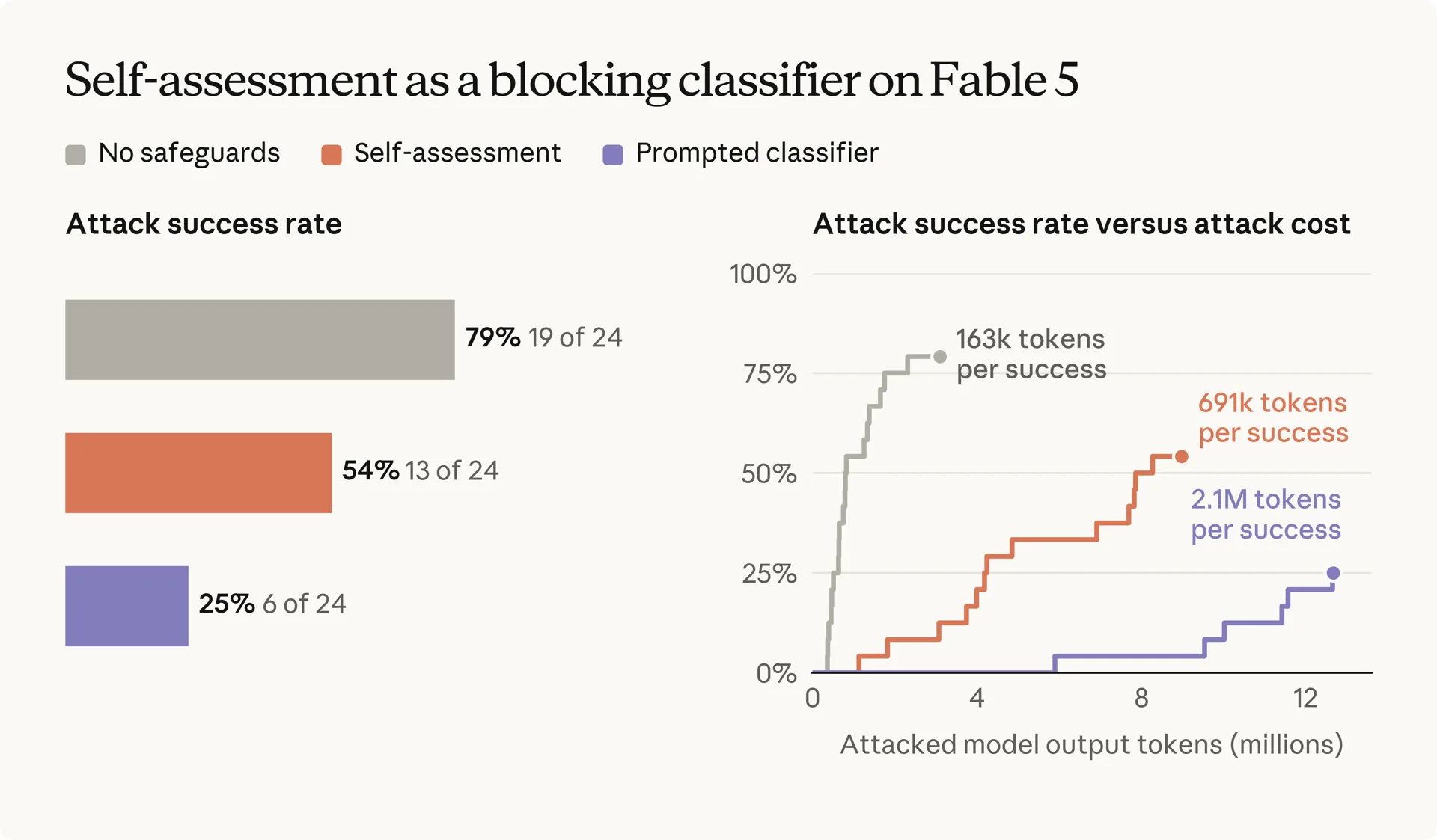
Anthropic did not oversell the tool, and the chart above shows why. As a lone blocker in red team tests, self assessment only cut attack success from 79 percent down to 54 percent. Plenty of attacks still got through when it stood guard by itself.
What it did change was the price of trying. Each successful attack cost roughly four times more, burning far more tokens per success. Safety work often wins exactly like that: not by building a perfect wall, but by making abuse slower, louder, and more expensive than it is worth.
Why builders should pay attention
Anyone shipping a product on top of an AI model inherits the abuse problem along with the capability. A built in review layer that flags misuse in context, written by the same system that saw the whole conversation, is a different tool than a keyword filter bolted on the side.
The Rundown AI named the fair caveat: a model grading its own chats can share the same blind spots as the model being graded. The honest setup is layers, with self assessment as one early warning among several, and humans making the final calls.
- Treat model self review as an early warning, never the only guard
- Route high urgency flags to humans first, by design
- Measure safety by attacker cost, not only by block rate
- Ask your AI provider what review layers run on your traffic
A referee who plays on the team
Letting the AI help police its own conversations sounds circular, and in part it is. But the reported catches, the published limits, and the cost curve all point the same way: this layer is catching real abuse that other systems missed.
After a year of reports about models being misused for cyberattacks and weapons work, a lab publishing both the wins and the failure rates is doing safety communication right. The rest of the industry should copy the honesty along with the technique.
Sources and further reading
Sources were checked for this article. Tool features, prices and availability can change. Product claims are attributed to their publishers.