Before Black Friday, Check Whether Your Ads Are Chasing Old Customers
DTC's October 13 edition reads the early October shopping signals and shares Pilothouse's four step check for keeping prospecting spend aimed at new customers before Black Friday.
October already graded your November
United States shoppers spent $9.86 billion online during Amazon's Prime Big Deal Days on October 6 and 7, up 8.5 percent from last year, across all online retail. Mobile drove 52 percent of that spending and grew 12.8 percent, so the first prep task is unglamorous: run your own checkout on a phone, start to finish, this week.
Gift buying has clearly started. Against average September levels, toy sales rose 158 percent, electronics 85 percent, and personal care 73 percent, while headphones and speakers jumped 300 percent. The deepest discounts topped out near 20 percent, and buy now pay later orders reached $692.3 million, appearing in 6 percent of orders but 7 percent of dollars. Adobe expects pay later spending to pass one billion dollars on Cyber Monday, so make the option visible on your higher priced products now.
The four step prospecting check
Meta's delivery system looks for people likely to purchase, and that includes people who already bought from you. Every prospecting dollar that lands on an old customer during Black Friday is a dollar that never met someone new. Pilothouse's Meta team runs this check before the rush:
- Tell Meta who your customers are: upload a current purchaser list, build a purchase event website audience, and sync purchaser audiences from Shopify or Klaviyo
- Set the campaign to acquire new customers, then confirm the exclusions underneath match the audiences you just defined
- If your pixel leans toward warm audiences, run a manual prospecting campaign that also excludes social engagers and website visitors at the ad set level
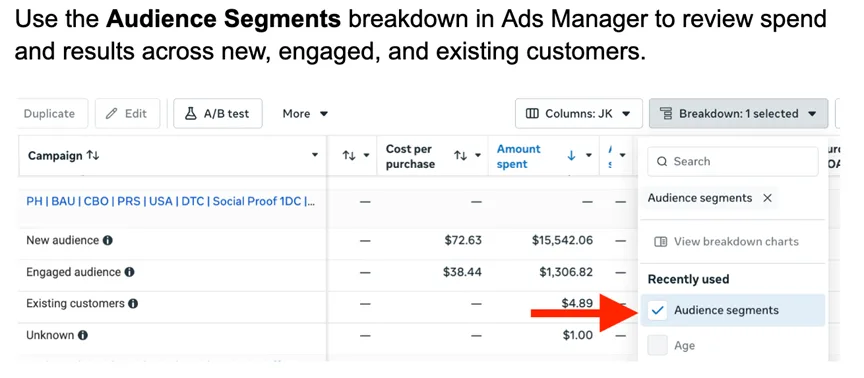
- Review the audience segments breakdown weekly: in Pilothouse's example, new audiences took $15,542 of about $16,855 in spend while existing customers took $4.89
Judge prospecting by its own benchmark
In that same example, a new customer cost $72.63 against $38.44 for an engaged one. Prospecting will always look more expensive on the dashboard. The question is whether the cost of a genuinely new customer is one your margins can accept, so compare it against store side new customer data instead of against the warm audience number.
Extra hours: let the agents gather, you decide
The same issue of DTC describes Pilothouse creative strategist Braydon's AI workflow, which saved him about 5.5 hours in one week. Agents sweep Pinterest, the Meta Ad Library, and Motion for UGC, static creative, and inspiration, then return a swipe file for his review. He picks the ideas worth pursuing, and Claude, loaded with account context, drafts the detailed tickets for designers.
That division of labor is the Black Friday lesson in one line. Machines are excellent at gathering and drafting. Humans keep the judgment: which customers the budget should chase, which discount the margin can survive, and which idea deserves a designer. Set the checks up in October, while there is still time to fix what they find.
Sources and further reading
Sources were checked for this article. Tool features, prices and availability can change. Product claims are attributed to their publishers.