Artificial Reef Startups Want to Rebuild Florida Beaches With AI
Coastal Assembly, an MIT startup, uses AI and marine concrete blocks to help beaches grow back, with Miami among its planned sites. The Hustle covers the Maldives proof, the money, and the other reef builders.
The beach is the product Florida cannot lose
Rising seas threaten far more than a nice view. The Hustle cites the scale plainly. Around 770 million people live just 16.4 feet above sea level, an estimated 1.2 billion people could be displaced by 2050, and coastal infrastructure damage already totals about 1.8 trillion dollars, with another 1.4 trillion possible without intervention.
Florida readers do not need the global math explained. Beaches here are housing, tourism, fisheries, and identity at once. The old fixes are weak. Seawalls can be expensive and can speed erosion nearby, while dredging sand destroys habitat and washes away. A better answer would work with the ocean instead of fighting it. That is the bet a group of startups is now making.
How Coastal Assembly grows a beach
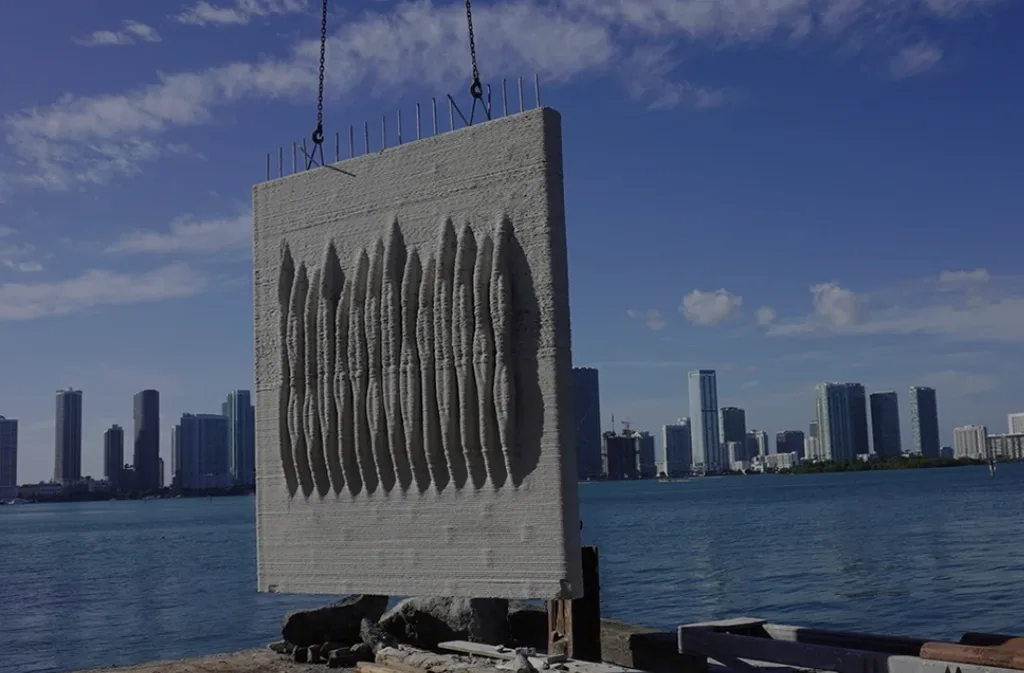
Coastal Assembly spun out of MIT, built on ten years of research at the Self Assembly Lab. As The Hustle describes it, citing Fast Company reporting, the company uses artificial intelligence to read satellite and ocean current data and predict where erosion will hit. Then it places custom blocks of marine concrete, shaped to resemble natural reefs, where the water itself can do the building.
The blocks break up waves, guide sand back toward the beach, and help keep it there, while also giving coral and marine life a place to live. Coral reefs can absorb 97 percent of shore bound wave energy, so a living structure protects in a way a plain wall cannot. Researchers keep tracking the shoreline and can adjust the structures as conditions change.
Proof in the Maldives, plans that include Miami
This is not only a pitch deck. After two years, the project doubled the depth of a beach in the Maldives. Ten more installations are planned in that area, with further work planned in the Bahamas, Miami, and Boston. The company has raised about 4.4 million dollars in venture backing, operates as a public benefit corporation, partners with the United Nations to help vulnerable communities, and earns revenue from commercial resorts.
Coastal Assembly is not alone in the water:
- Kind Designs has raised 21.5 million dollars to build living seawalls and artificial reefs that protect shorelines, including work in Florida waters
- Reefy, based in the Netherlands, builds artificial reefs from low carbon concrete
- Louisiana startups are working on protection for low lying coastal areas, and older projects even sank subway cars as reefs along the Atlantic coast
Why Florida creators should watch the shoreline business
Coastal work is becoming a real Florida industry, with startups, resorts, cities, and researchers all needing to show progress to the public. Every installation is a story that needs filming, photography, and clear explanation, because a concrete block underwater only wins support when people above water can see what it changed.
There is a broader lesson for founders too. Coastal Assembly sells an outcome everyone can picture, a beach that grows instead of shrinking, and it proved that outcome in one place before raising money to repeat it. Start with proof in one location, measure it honestly, then scale. That sequence works for reef builders, and it works for almost every service business in Florida.
Sources and further reading
- The Hustle: The tide is high, artificial reef startups rebuilding beaches (October 16, 2026)
- Fast Company: This MIT spinout designed an artificial reef to save shrinking beaches (2026)
Sources were checked for this article. Tool features, prices and availability can change. Product claims are attributed to their publishers.