Mercury 3 Drafts Answers All at Once and It Is Very Fast
Inception launched Mercury 3, a diffusion language model that drafts many words at once instead of one at a time. The Rundown reports output above 1,000 tokens a second and pricing at 0.20 and 0.70 dollars per million tokens, and The Neuron test of eight runs cost about four cents in total.
A different way to write, not just a faster chip
Most language models write one token at a time, left to right, like a person typing without ever deleting. Inception Mercury 3 works differently. It is a diffusion model, which drafts many words at once and then refines them, more like an editor revising a whole draft than a typist composing a sentence. The Rundown reports that this approach produces output above 1,000 tokens a second.
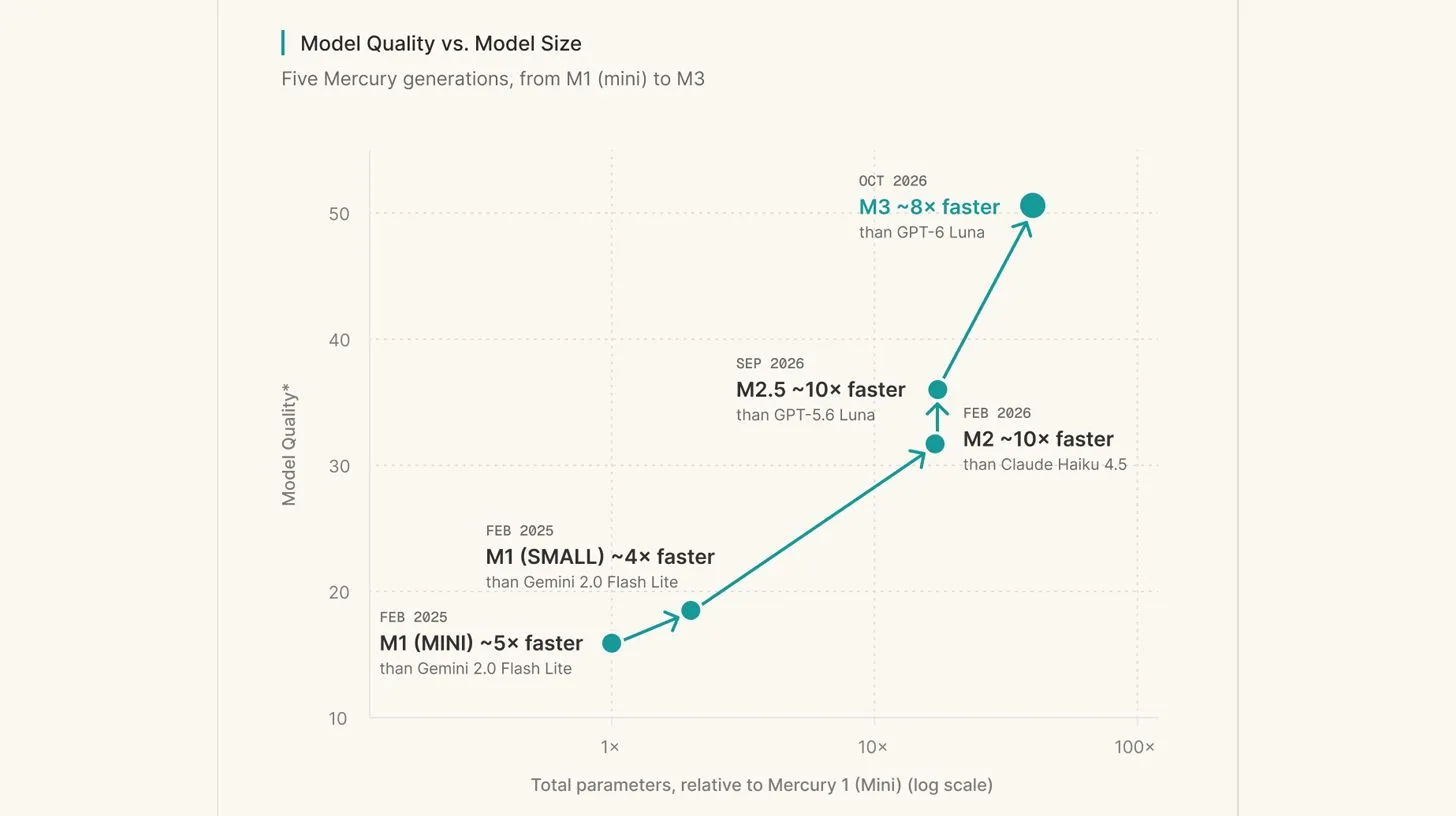
Inception says Mercury 3 matches or beats GPT 6 Luna and Claude Haiku 5.5 on its own numbers while running four to eight times faster, and that it is 40 times the size of Mercury 1 while holding the same speed. Pricing is 0.20 dollars per million input tokens and 0.70 dollars per million output tokens. Those quality claims are the company own, and both newsletters treat them that way.
Where speed actually changes the product
Mercury will not replace the frontier models people use for hard reasoning, and Inception is not pretending otherwise. Speed wins a different set of jobs, the ones where any lag is visible to a user:
- Live tutors that have to answer while a student is still paying attention
- Voice customer support, where a pause feels like a failure
- Web browsing agents that take many small steps in a row
- Any app where a person waits on screen while the model thinks
One tester ran eight trials for about four cents
The Neuron adds the most practical part of the story. Corey Noles ran Mercury 3 through eight API runs, including a constrained science fiction story, a coffee shop math problem, an explain it three ways prompt, a single file dungeon crawler game, a made up NASA mission designed to catch invented facts, and a classic logic puzzle. The whole bill came to about four cents.
The results were mixed in instructive ways. The math was essentially right, including a 900 dollar daily gross profit figure, and it questioned the problem assumptions. The game code passed a syntax check and 2,000 randomized map checks with no failures. The story ran about 274 words against a 250 word limit, and on the fake NASA mission it flagged the fabrication but added an unrelated error of its own. Fast and cheap did not mean careless, and it did not mean flawless either.
Steal the test kit for your own work
The method matters more than the model. Corey advice, as reported by The Neuron, is to test any new model on tasks from your actual work instead of trusting launch charts: one task with strict limits, one math word problem, one coding or building request, and one question built on a fake premise to see whether it invents facts.
Then grade the misses instead of the vibes. Count the words when a limit was set. Check the arithmetic by hand. Open the code and run it. A model that fails your own test in a way you can see is giving you more information than a benchmark chart from the company selling it.
Why creators should care about a speed race
The Rundown notes that OpenAI is pushing speed too, with a Cerebras partnership and an Ultrafast tier for GPT 6 Astra reaching as high as 300 tokens a second. When answers arrive almost instantly and cost almost nothing, the bottleneck in creative work moves. It stops being generation and becomes selection: which draft, which take, which idea is actually good.
That is good news for people with taste and bad news for people selling raw output by the hour. Try Mercury Chat or OpenRouter with the four cent test above, run it against the tools you already pay for, and let your own work decide. Speed is clearly the next battleground, and small teams that test early will know exactly where the new models fit before their competitors do.
See creative direction pricing
Sources and further reading
- The Rundown AI: Inception Mercury 3 speeds past rivals (October 20, 2026)
- The Neuron: Test a new AI model on your own work for about four cents (October 20, 2026)
Sources were checked for this article. Tool features, prices and availability can change. Product claims are attributed to their publishers.