ChatGPT Ads Can Target You by Your Prompts and Your Email List
404 Media bought ads inside ChatGPT to test how targeting works. The Neuron explains the two routes in, the list size rules, and why turning personalization off does less than people expect.
A newsroom bought the ad to explain the ad
404 Media wanted to show how ChatGPT advertising works, so it became an advertiser. The outlet ran ads inside ChatGPT with a simple privacy message, aimed at people asking about privacy and AI. The Neuron covered the test because the stunt is not the story. The targeting tools behind it are.
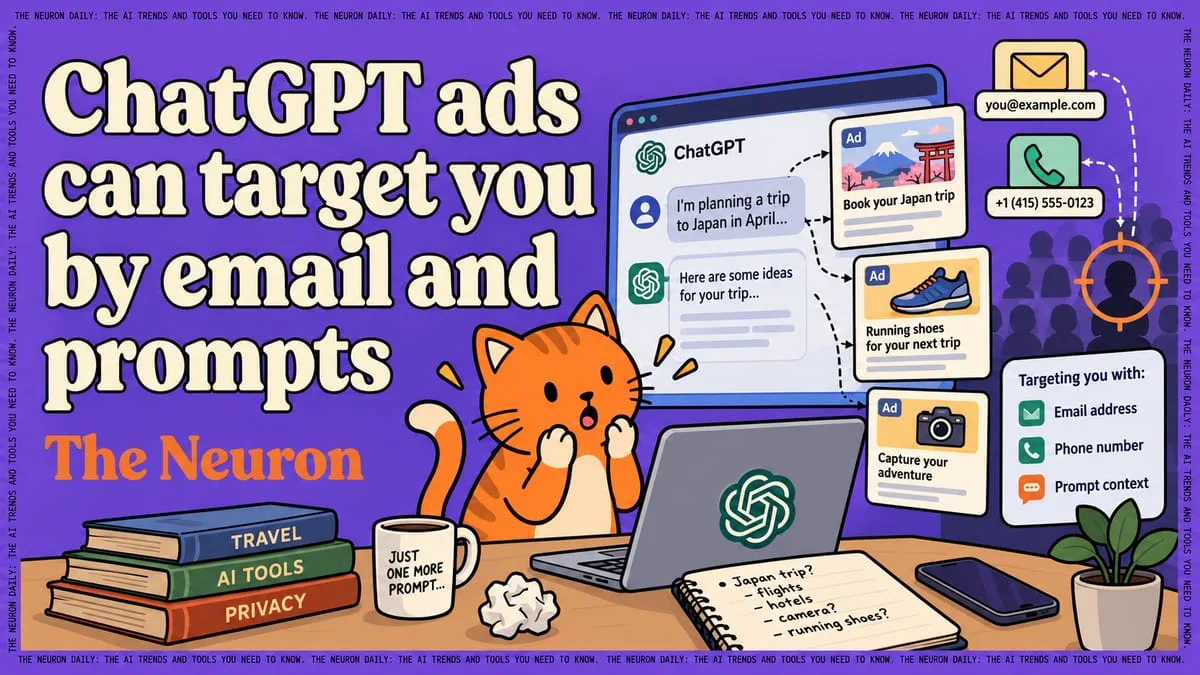
Reporter Joseph Cox found that advertisers can reach people in two distinct ways. One follows what a person is asking about right now. The other follows who the person is, using contact details the advertiser already holds. Together, they turn a chat window into an ad surface that feels a lot like search and social combined.
The two routes in
The first route uses context. Advertisers describe topics or keywords, and OpenAI says those hints guide matching without acting as exact match rules. Think of it as a looser version of search keyword ads, pointed at a live conversation instead of a results page.
The second route uses uploaded lists:
- Advertisers can upload emails, phone numbers, or Android advertising IDs, and OpenAI matches them to ChatGPT accounts
- Lists with more than 25,000 entries can be used to target people, while smaller lists can only be used to exclude people
- Uploads can be raw or hashed, OpenAI says files are deleted after processing, usually within 24 hours, and advertisers cannot see which individuals matched
Off means less, not none
Users can turn off ads personalization, but 404 Media found that the setting does not stop ads or all tracking. The setting itself says ads may still be based on your current chat. In plain terms, the conversation you are having right now can still shape the ad you see, even with personalization off.
Scale is the other part of the story. Customer list targeting is standard practice across advertising, and The Neuron is careful to say so. What is new is the setting. Most of ChatGPT roughly one billion monthly users, by the estimate cited in the coverage, likely have no idea a prompt can function like a search query in an ad system.
What this means if you buy or sell attention
For marketers, a new placement is opening with unusually clear intent. A person asking a chatbot for help planning, buying, or fixing something is signaling a need in full sentences. Brands that learn this surface early, with honest offers and clean list practices, will have an edge as pricing and formats settle.
For everyone else, treat a chatbot conversation the way you treat a search box. Ask what you need, but know the topic of your chat can shape commercial messages around the answer. And if you run a business, assume your customers will soon meet your competitors inside the same chat where they ask about your category. Being the name they already trust is the defense no targeting setting can switch off.
Sources and further reading
- The Neuron: Advertisers can target ChatGPT by prompt (October 16, 2026)
- 404 Media: How ChatGPT targets ads to you based on your prompts, phone number, and email (October 15, 2026)
Sources were checked for this article. Tool features, prices and availability can change. Product claims are attributed to their publishers.